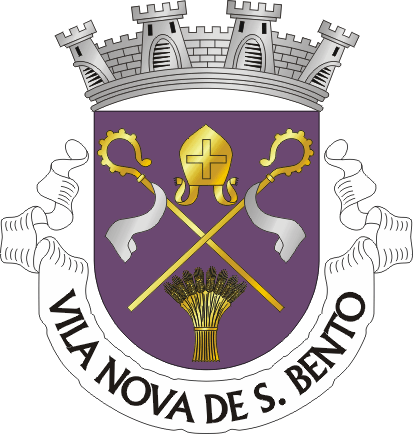
history
Vila Nova de São Bento is a parish in the municipality of Serpa, in the Baixo Alentejo, covering 241.69 km² and home to 2,612 inhabitants (2021). Until 1988 it was known as Aldeia Nova de São Bento, the name under which it appears in censuses (as Aldeia Nova) between 1864 and 1930; it was granted town status on 19 April 1988. Between 2013 and 2025 it was merged with Vale de Vargo, forming the União das Freguesias de Vila Nova de São Bento e Vale de Vargo, and was restored as a separate parish by Lei n.º 25-A/2025, of 14 March. The population reached 8,842 inhabitants in 1950. A legend links the origin of the village to the union of two settlements, Aldeia da Fonte do Canto and Cabeço de Vaqueiros, at the time of the Restoration of 1640, and the name to São Bento, the patron saint. The heritage includes the Igreja de São Bento (Church of São Bento), at the entrance to the town, the Igreja de São Francisco, the Capela de Nossa Senhora do Desterro, at the Herdade da Abóbada, and the Cruzeiro, in Altinho; nearby are the Facho and Vareta dams, the Aldeia do Pinto and the Crossódromo da Atalaia. The festivities include that of São Sebastião, on 20 January, with a mass, procession and auction of offerings; the Festas das Santas Cruzes, in early May, with a procession to the Cruzeiro over beds of rosemary and houses adorned with 'Santa Cruz' altars; and the annual fair on the last weekend of July, established in 1899. Os mangotes da Aldeia Nova, a traditional pork sausage from the Alentejo, are the centrepiece of Christmas and of the annual pig slaughter.