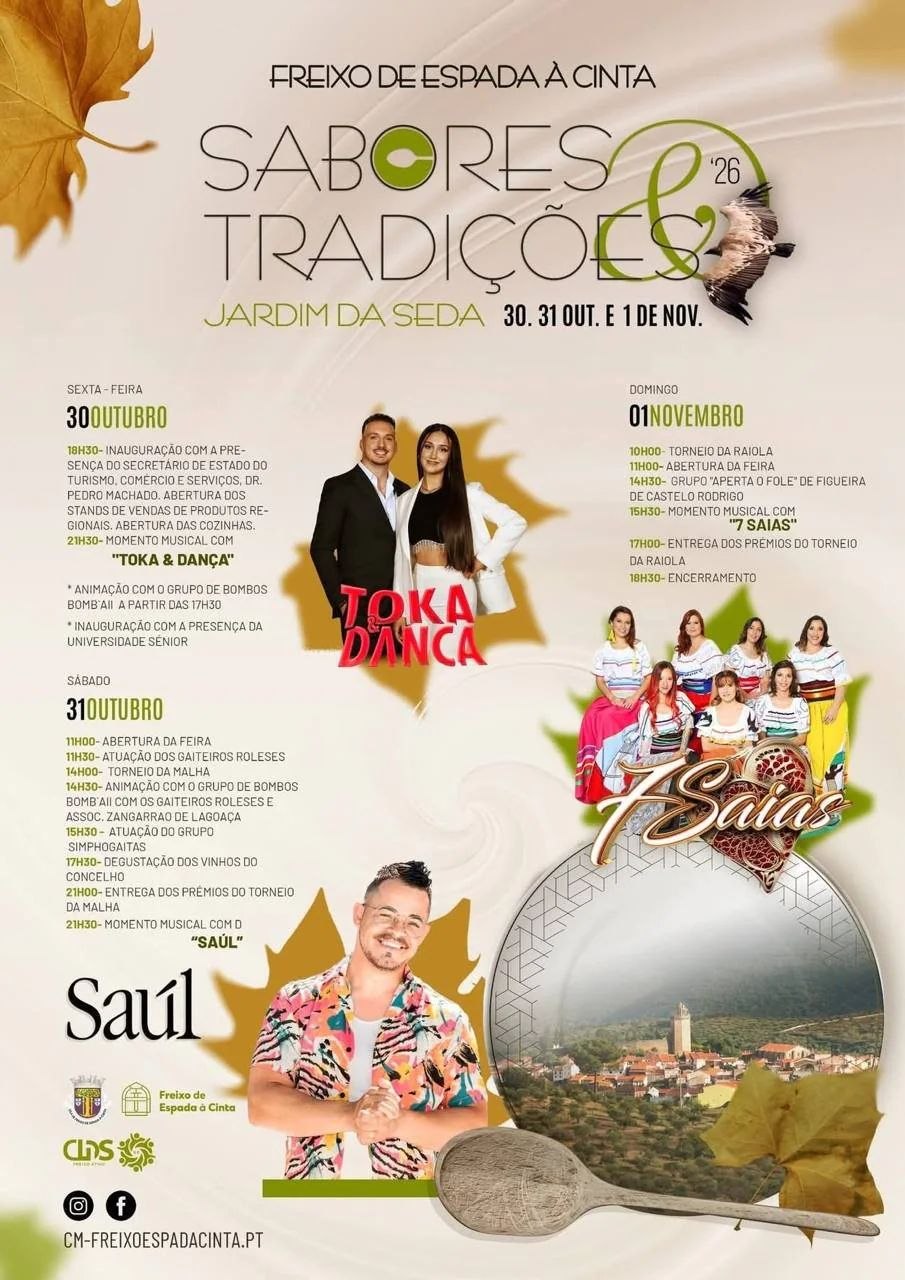
about the place
In the far east of Trás-os-Montes, in the municipality of Freixo de Espada à Cinta, this union of parishes spreads across terraces of almond and olive trees, close to the border. The Igreja Matriz de Freixo de Espada à Cinta (Parish Church), classified as a National Monument and featuring Manueline elements, is its greatest landmark. In Mazouco, rock engravings are preserved, recognised as a site of public interest.
history
In the far east of Trás-os-Montes, where the land folds into terraces and the sun seems to linger longer than anywhere else in the country, lies the União das Freguesias de Freixo de Espada à Cinta e Mazouco. It is a borderland of golden light and wide silences, where two neighbouring villages share the same almond-blossom horizon and the same stubborn attachment to the harsh beauty of these hills.<p>Freixo de Espada à Cinta carries, in its stones, memories that span generations. It is a town of streets that rise and fall with the lie of the land, of old houses that still speak, through their coats of arms and doorways, of the slow passage of centuries. Here the people learned to cultivate what the land offers without complaint: the almond tree, which blooms in white and pink while winter has not yet given up, and the olive tree, which withstands cold and heat with equal dignity. Mazouco, for its part, is a more withdrawn place, a village that lives at its own quiet pace, where field and home touch one another and where daily life still follows the rhythm of the seasons. Together, these two villages form a territory that cannot be rushed — it asks for time, it asks for a lingering gaze.<p>The heritage of these lands is the kind that stays in the memory. The Igreja Matriz de Freixo de Espada à Cinta (Parish Church) is the great pride and principal landmark of this landscape: listed as a Monumento Nacional (National Monument), it stands with the solemnity of something built to last and to lift the eyes of all who pass. It is one of those temples where art and faith embrace, and where every detail was conceived to resist oblivion. Nearby, the Igreja do Convento de São Filipe Nery adds another layer of contemplation and devotion to this town that has long known how to keep the sacred alive in its stones. And because the history of these lands is also woven with threads — quite literally — the Museu da Seda e do Território preserves the memory of an ancient craft, of an activity that shaped both people and landscape, and which is kept alive today so that the trace of those who spun and wove their livelihood and their art here is never lost.<p>The traditions of this land have deep roots and a rhythm of their own, bound to the calendar and the seasons. Among the customs that best define the soul of the place is a ritual observed across the seven Fridays that follow Carnival — a marked time of patient repetition, in which the community recognises itself in its inherited gestures. These rituals, made of faith and belonging, keep alive the identity of those born here and of those who return, year after year, to ensure that what their forebears taught them does not die.<p>At the table, these lands offer the best of what nature provides and what skilled hands can transform. Wine flows generously, the companion of any gathering, and the almond — queen of these fields — finds its way into traditional sweets that grace celebrations and days of welcome. The olive oil and olives, gathered from the trees that dot the landscape, lend flavour and character to everything that is cooked. The cuisine is rooted in the Transmontana tradition, honest and comforting: the artisan soups — made with tomato, garlic, potato, egg or asparagus — warm both body and conversation; the posta (a thick grilled beef steak), grilled with simplicity and respect for the meat, fills the plate with flavour; the roast lamb arrives at special occasions with an aroma that heralds celebration; the game dishes recall the ancient bond between these people, their land, and its seasons; and the feijoadas (hearty bean stews) are served in generous portions, to strengthen those who work and gladden those who sit down together. It is a cuisine that needs no artifice — the quality of what the land produces and the hand of those who cook from memory are more than enough.<p>To visit Freixo de Espada à Cinta e Mazouco is to surrender to a Portugal that holds its ground, true to itself. It is to feel the border without crossing it, to taste a freshly picked almond, to step inside a church where time has slowed, and to leave with the certainty that there are places one never forgets.