history
Sete Cidades is a parish of the municipality of Ponta Delgada, on the island of São Miguel, in the Azores, with 19.22 km² and 701 inhabitants in the 2021 census, about 36 inhabitants per km². It lies at about 260 metres above sea level, inside the caldera of the Sete Cidades volcano, on the eastern shore of the lake. It was created by Decree-Law no. 40/71 of 18 February, from places taken from the parish of Ginetes, and its patron saint is Saint Nicholas.
The name comes from the legendary Seven Cities of the Atlantic: when the Portuguese settled the island, they gave the volcano's central caldera the name of that legendary land. The caldera was formed by successive collapses and is one of the largest collapse calderas in the world. The Sete Cidades Lake, with 4.45 km², is the largest natural surface freshwater reservoir in the Azores; its water has two colours, green and blue, separated by a channel with a low bridge, and it has been a Protected Landscape since 1980.
The Church of Saint Nicholas was built to fulfil a vow made in 1849 by Colonel Nicolau Maria Raposo de Amaral and his wife, Teresa Ermelinda Rebelo. The neo-Gothic design is by Manuel Lamberto Monteiro, who directed the works, and the church was consecrated on 16 August 1857. It was donated to the people in 1969 and became a parish church on 23 May of that year.
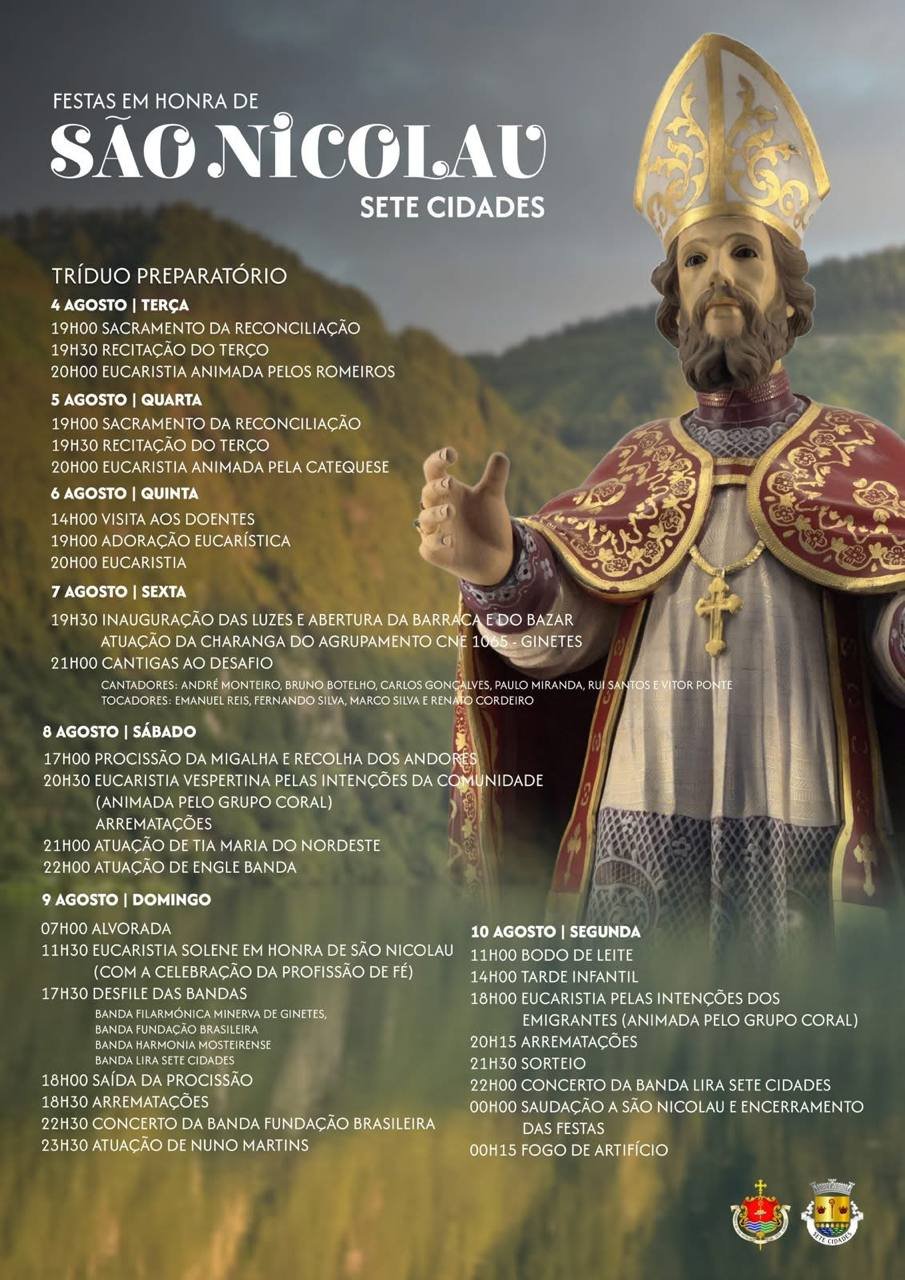
To visit: the Church of Saint Nicholas; the Sete Cidades Lake, with the Blue Lake and the Green Lake; the lake's drainage tunnel, opened in 1937; the house of the heirs of Caetano de Andrade; the traditional houses, with granaries on tall legs; and, around the caldera, the Cerrado das Freiras viewpoint and Pico das Éguas, 873 metres high. In August the parish holds the Saint Nicholas Festival.